Art. 1 - Place and date
The Club de Automóviles Sport (CAS), affiliated with F.I.V.A., is organizing an international regularity event for classic sports cars listed on the F.I.V.A. calendar and part of the ACA’s Argentine Historic Sports Car Championship known as the “1000 Millas Sport de la República Argentina,” to be held on the roads of Río Negro and Neuquén provinces on November 25, 26, 27, and 28, 2026.
Art. 2 - Officials of the Organizing Club
President: Sr. Fernando Briones
Vice President: Sr. Edgardo Petrizzo
Secretary: Sr. Alejandro Schiaffino
Treasurer: Sr. Jorge Saud
Secretary: Sr. Alec Daly
Assistant Treasurer: Leandro Gargiulo
Racing Secretary: Sr. Hernán Silva
Rally Secretary: Joaquín Vallejo
Vowels: Sr. Marcelo Jurvillier y Guillermo Iriarte
Audit Committee: Sres. César Litvin y Rodolfo González
Court of Honor: Sres. Damián Pozzoli y Fernando Vallejo
Art. 3 - Route
The event will start and finish in the city of Bariloche (Río Negro Province). The total route is approximately 1,305 km, subdivided into the following stages.:
- November 26: Llao Llao – Circuito Chico – Circunvalación – Pitba – Dina Huapi – -Villa La Angostura – Reserva Natural – 7 Lagos – Paso Cardenal Samore – Lumaia – Villa La Angostura – Villa Lanquino – Dina Huapi – Los Juncos- Dina Huapi- Llao Llao
- November 27: Llao Llao – Bariloche–- Villa la Angostura – Camino de los 7 Lagos – San Martin de Los Andes – – Junin de los Andes- Alicura – Confluencia – Villa Lanquin -Bariloche – Llao Llao.
- November 30: Llao Llao – Circuito Chico – Cerro Catedral – Villa Mascardi – El Bolson – Baqueanos – Cerro Catedral – Llao Llao.
Art. 4 - Eligible vehicles
Vehicles approved under the “Historic Sports Cars” list registered for road use with the necessary documentation and license plates (or other acceptable registration documents) and insured for participation in regularity competitions may be admitted to the event, divided into the following categories:
Category C: vehicles manufactured up to December 31, 1930
Category D: vehicles manufactured between January 1, 1931, and December 31, 1945
Category E: vehicles manufactured between January 1, 1946, and December 31, 1960
Category F: vehicles manufactured between January 1, 1961, and December 31, 1970
Category G: vehicles manufactured between January 1, 1971, and 2000
Art. 5 - Type-approval certificate
All automobiles must have the passport issued by the F.I.V.A.
Art. 6 - Participants and facilitators
For each car, a crew consisting of a driver and a navigator must be registered; both must hold a sporting license issued by the CDA of the ACA for this activity and, if driving, a driver’s license authorizing them to operate the vehicle in accordance with current regulations. Passengers are not permitted.
Art. 7 - Registration
For organizational reasons, a maximum limit of 100 participating cars has been established. Only registrations with fully completed forms will be considered, provided the required documentation has been received (FIVA ID card, insurance covering regularity rallies, and an ACA sporting license for the crew) and the full registration fee has been paid by the closing date.
Registrations will be accepted until September 28, 2026. Selection criteria will prioritize cars homologated on the ACA’s “Historic Sports Cars” list; within this group, priority will be given to older vehicles and/or those deemed of special historical interest by the organizing committee, whose decision is final. Cars listed as “conditional” are considered to hold less special historical interest. The organizer may limit the number of cars per category, following the criteria outlined in the previous paragraph.
Registrations must be submitted via the form on the website www.1000millas.com applicants may access the site at any time to complete missing information prior to the registration deadline.
Once the selection of participating cars is complete, the accepted participant acknowledges that a car other than the one originally accepted will not be considered registered.
If valid registrations exceed the limit by the closing date, a selection process will be conducted, and the full fee will be refunded to those not accepted. In the event of *force majeure* and subject to the Organizing Committee’s approval, the substitution of the originally accepted car may be authorized. The replacement vehicle must be included on the list of homologated cars and as a sine qua non condition its year of manufacture must be the same as or earlier than that of the replaced car. Under no circumstances will a car of a later model year be accepted. Entries will be accepted via the form on the website www.1000millas.com.
Cars that are not selected will be placed on a waiting list in the event of a cancellation by one of the accepted entrants.
Art. 8 - Publicity
Unofficial advertising on the vehicles is strictly prohibited. The names of the driver and co-driver may appear only once on each side of the vehicle, in letters with a maximum height of 10 cm and within a rectangle measuring 10 cm by 40 cm. No other form of advertising not expressly authorized by F.I.V.A. may appear on the car.
The Organizing Committee reserves the right to reject the participation and entry of any car displaying unauthorized advertising. Such rejection is at the organizer’s discretion and is not subject to appeal.
Art. 9 - Technical control
Vehicles must be presented to the technical inspector in their original condition, in perfect working order, and with an impeccable appearance.
Inspections will cover the condition of tires, lights, brakes, and the vehicle’s general state, as well as the fire extinguisher.
Failure to meet even one of these requirements will result in the vehicle being barred from the event. This decision is final and will be made by the race officials after consulting the technical inspectors.
Any element protruding beyond the bodywork not originally provided by the manufacturer that is intended to display timing data is prohibited.
Vehicles must meet all requirements for road legality and be equipped solely with tires homologated for standard road use. “Slick” tires are strictly prohibited.
Art. 10 - Start
Signals for the start of the event and for special test sections are given individually with the car at a standstill and the engine running, using the following verbal countdown:
– 20 seconds; -10 seconds; -5 seconds; – START!
The final five seconds are counted off individually. If a participant is unable to start when signaled, they may be pushed to get moving (under the supervision of a race official), subject to a maximum delay of 15 seconds. A participant who fails to start when called may start their timer and depart without passing through the starting gate up to 15 minutes after the final car has started. Participants will start at 20-second intervals.
Art. 11 - Time and distance instruments
The use of measuring instruments is not subject to any type of restriction.
Art. 12 - Ordering
Overtaking the organization vehicle identified as “0” is strictly prohibited.
Participants with car numbers between 1 and 30 may not overtake the organization vehicle identified as “0”.
- Between 31 and 60, to the vehicle identified as “30”.
Art. 13 - Assistance I
Participants whose support vehicles overtake other competitors on unpaved sections where such vehicles are required to follow the organization vehicles mentioned in the preceding article will be penalized. Likewise, participants whose support vehicles overtake other competitors in time control zones will be penalized.
Art. 14 - Assistance II
There will be no service park.
Art. 15 - Reorganization point
There will be no reorganization point.
Art. 16 - Maximum time
A participant will be considered to have exceeded the maximum time allowed:
If they pass through any time control with a delay of 15 minutes or more relative to their scheduled passing time.
Art. 17 - Specific rules
For rules concerning the route, competition numbers, signals for officials, start-list assistance signals, time controls, stamp controls, secret controls, route markers, penalties, insurance, and information bulletins, please refer to the F.I.V.A. Regulations. A “Parc Fermé” will not be used either during or after the event.
See Special Tests Regulations.
Art. 18 - Driver behavior
Throughout the race, drivers must strictly observe all Traffic Code regulations, drive prudently, and follow all instructions given by the Event Director.
Leaning out of a moving car is strictly prohibited.
The sections between the yellow control zone warning sign and the end of the control zone may only be traversed while inside the respective vehicle.
At the request of the Race Director (or their authorized representative), the Steward has the authority to remove a participant’s numbers and exclude them not only from the classification but also from the event itself if their behavior is deemed to compromise the safety of other participants or the event itself.
Art. 19 - Penalties and Exclusions
For penalties and exclusions, please refer to our Special Tests Regulations.
Art. 20 - Finish
Car No. 1 is scheduled to arrive at the following times and locations:
- November 26 at 5:30 PM at PUMA Cerro Leones
- November 27 at 6:30 PM in Bariloche
- November 28 at 4:30 PM at Llao Llao
Art. 21 - Classification
The results will be divided into:
Art. 22 - Publication of results
The results will be published at 9:30 PM on November 29, 2024, in the lobby of the Llao Llao Hotel.
Art. 23 - Awards
The following honorary awards will be presented:
- To the first, second, and third-place finishers in each category (Drivers A, B, and C), based on the ACA Priority Drivers list.
- To the top twenty finishers in the overall results.
- The “LORY BARRA” Challenger Cup to the highest-placed CAS member.
- Sportsmanship Cup.
- To the competitor with the highest total of Absolute Points.
- Racing teams.
- “Luciano Viaro” a la mejor Tripulación Extranjera.
Teams for the 2026 1000 Millas
Teams must consist of a minimum of 2 and a maximum of 5 participants; each team member is assigned a handicap.
Handicap = 20 – Average based on ACA Priority Drivers
For any participant whose Priority Driver average exceeds 20, or who does not appear on the Priority Driver list, the value is capped at 20. In this case, the participant’s handicap will be 0 (20 – 20).
A team’s score is the average of the scores achieved by each participant. A participant’s race score is calculated as follows: Driver A Score = Race average + Handicap
The team with the lowest score wins.
Example:
Based on Priority Drivers:
Driver A: Level 5, Driver B: 12, Driver C: Level 3, Driver D: Level 16, Driver E: Level 8.
Team 1: Driver A (Handicap: 15), Driver B (Handicap: 8)
Team 2: Driver C (Handicap: 17), Driver D (Handicap: 4), Driver E (Handicap: 12)
Race Result:
Driver A: Average 4.5, Driver B: 13.2, Driver C: 3.6, Driver D: 14.4, Driver E: 7.4
Team 1: (Driver A + Driver B) / 2 = ((4.5 + 15) + (13.2 + 8)) / 2 = 20.35
Team 2: (Driver C + Driver D + Driver E) / 3 = ((3.6 + 17) + (14.4 + 4) + (7.4 + 12)) / 3 = 19.47.
Winner: Team 2
Art. 24 - Claims
All protests must be submitted in writing and accompanied by a deposit of US$300 (three hundred). The deposit will be refunded only if the protest is upheld.
Please note the following:
- Any protest regarding the validity of an entry or the eligibility of participants, drivers, or vehicles must be submitted no later than one (1) hour after the conclusion of pre-event scrutineering.
- Any protest regarding the formation of groups or classes must be submitted within one (1) hour of their publication.
- Any protest regarding an error or irregularity in the results list must be submitted within fifteen (15) minutes of the publication of the results approved by the officials.
Art. 25 - General rules
Upon registration, each participant:
- Declares that they are aware of and agree to abide by these regulations, which comply with the General Regularity Regulations for Historic Sports Cars issued by the CDA of the ACA (the latter being the governing authority in the event of a conflict).
- Recognizes F.I.V.A. as the sole competent legal authority.
- Consequently, waives the right to appeal to an arbitration tribunal or any other legal authority regarding matters arising from the organizers’ actions or the conduct of the event.
- Agrees to hold the CLUB DE AUTOMOVILES SPORT (CAS), the organizers, all event officials, and the owners of the roads and circuits used for the race harmless and free from liability regarding any damage or injury caused by third parties to participants, drivers, passengers, employees, or property, and vice versa.
- The road book is intended solely for route navigation and serves no sporting purpose.
Art. 26 - Race organizing committee and officials
ORGANIZING COMMITTEE
Managing director: Sr. Fernando Briones
Executive Director: Sr. Daniel Claramunt
Secretary for Participant Relations: Carlos Briones
Production: Claramunt Garage
Treasurer: Jorge Saud
Hospitality:
CAREER OFFICERS
Race Director: Sr. Carlos Pascualini
Stewards: Fernando Briones, Daniel Claramunt, Edgardo Petrizzo
FIVA Steward: Designado por la FIVA
CDA Race Steward: Sr. Nestor Garcia
Timing: Escuderia Norte
Approved by: Club de Automóviles Sport Argentina – Race Director
PENALTIES
Controls – Seal (C.S.)
Checkpoint controls will be located along the route to ensure drivers adhere to the established course. Please note that these checkpoints operate on individual schedules for each driver. Passing through a checkpoint ahead of the scheduled time—as confirmed on the driver’s own route card—incurs a penalty of 300 points per minute or fraction thereof. At each checkpoint, the driver receives an official stamp on said card.
Maximum penalty: EXCLUSION. Drivers are not required to exit their vehicles.
Secret Controls
Secret checkpoints will be positioned along the route to monitor compliance with the average speed limit; passing a checkpoint ahead of the theoretical time is strictly prohibited.
Times at secret checkpoints will be recorded in minutes. Penalty method:
– For a participant passing up to 15 minutes late relative to their theoretical schedule:
Penalty: zero points. After 15 minutes: 500 points.
– Participants will also be penalized if they fail to comply with the maximum speed limits at secret checkpoints equipped with radar:
Penalty: 300 penalty points.
Timekeeping Controls (C.H.)
Time Controls will be located along the route for the purpose of assigning penalty points. Times at the Time Controls will be recorded to the hundredth of a second.
Participants may wait outside the control area for as long as they wish before passing through it at the scheduled time.
Drivers will incur the following penalty points:
For each hundredth of a second (early or late) relative to the target time set for each control
Penalty: 1 penalty point.
Maximum penalty
Penalty: 100 penalty points.
Passing through more than 15 minutes behind the target time
Penalty: exclusion.
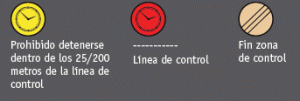
No one may stop within the control zone marked between the yellow sign and the beige sign.
Penalty: 100 penalty points.
Signs:
Timed Tests (T.T.)
Timed Tests will be located along the route for the purpose of assigning penalty points. Times for the Timed Tests will be recorded to the hundredth of a second.
Participants may wait outside the control area for as long as they wish before entering, but must remain inside the area only for the time required to complete the control procedure.
Drivers will incur the following penalty points:
For each hundredth of a second deviation (plus or minus) from the target time set for each control
Penalty: 1 penalty point
Maximum penalty
Penalty: 100 penalty points
Passing through more than 15 minutes after the target passing time
Penalty: Exclusion.
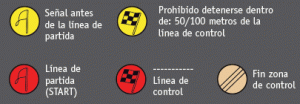
Stopping within the control zone—the area marked between the yellow sign and the beige sign—is prohibited.
Penalty: 100 penalty points.
Signs:
At the end of the Skills Test, participants must continue without stopping.
The following will be excluded from the classification:
A) Participants who do not display their competition number.
B) Participants who do not follow the planned route.
C) Participants who arrive at a Time Control (C.H.), Passage Control (P.C.), or Stop Control (C.S.) more than 15 minutes after their OWN THEORETICAL TIME.
D) Participants who fail to pass through a time control (C.H., C.P., P.P.I., or C.S.).
An exception may be granted to a driver who, for technical reasons, missed a time control or passage control (which may be a secret control) during a stage. They may be readmitted to the following stage (day) with a penalty of 100 points for each missed control plus a 500-point fine, provided that, within 30 minutes of the stage classification being posted, the participant informs the Event Director in writing of their intention to continue in the event. Each case will be decided by Event Management. This exception does not apply to the final stage of the event:
E) Participants who remove Official Sponsor advertising.
F) Participants who do not display their license plates.
G) Participants who have lost or altered their road books.
H) Participants who fail to behave properly toward other participants, as determined by the Event Stewards (whose decisions are final and not open to dispute).
I) Participants who violate the Traffic Code.
J) Participants who are towed during any part of the route, whether during competitive sections or liaison sections.
K) Participants who pass through a control in the wrong direction.
L) Leaning out of a moving vehicle: penalties range from the maximum penalty at the specific control to exclusion.
M) Participants whose support crews overtake competitors in areas not permitted by Article 13 will be penalized with anything from a reprimand to exclusion.
CLASSIFICATION
The final classification will be determined as follows:
- General Classification Classification by Driver Categories (A, B, C)
- Team Classification
- Classification by Absolute Points
The overall winner of the “2023 1000 Millas Sport de la República Argentina” will be the participant who accumulates the lowest number of penalty points, after discarding the test with the highest penalty from both the first and second stages (one discard per stage). No discards apply to the third stage.
Once the penalty points are tallied, the resulting score will be multiplied by a specific coefficient assigned to each car. The coefficient for each car is determined by its year of manufacture. All cars built prior to January 1, 1931, will be treated as if built in 1930, regardless of their actual manufacture date; penalty points for these vehicles will be calculated by multiplying the penalties by 1.30.
Example: A 1950 car will have a coefficient of 1.50, which will be multiplied by the accumulated penalty points. In the general classification, in the event of a tie (equal total points), the older car will take the higher position.